English
 Arabic
 French
 Spanish
 Portuguese
 Deutsch
 Turkish
 Dutch
Dutch
 Italiano
 Russian
 Romaian
 Portuguese (Brazil)
 Greek
Greek

📟Root Termux
Other |
2026-05-30 08:45:23
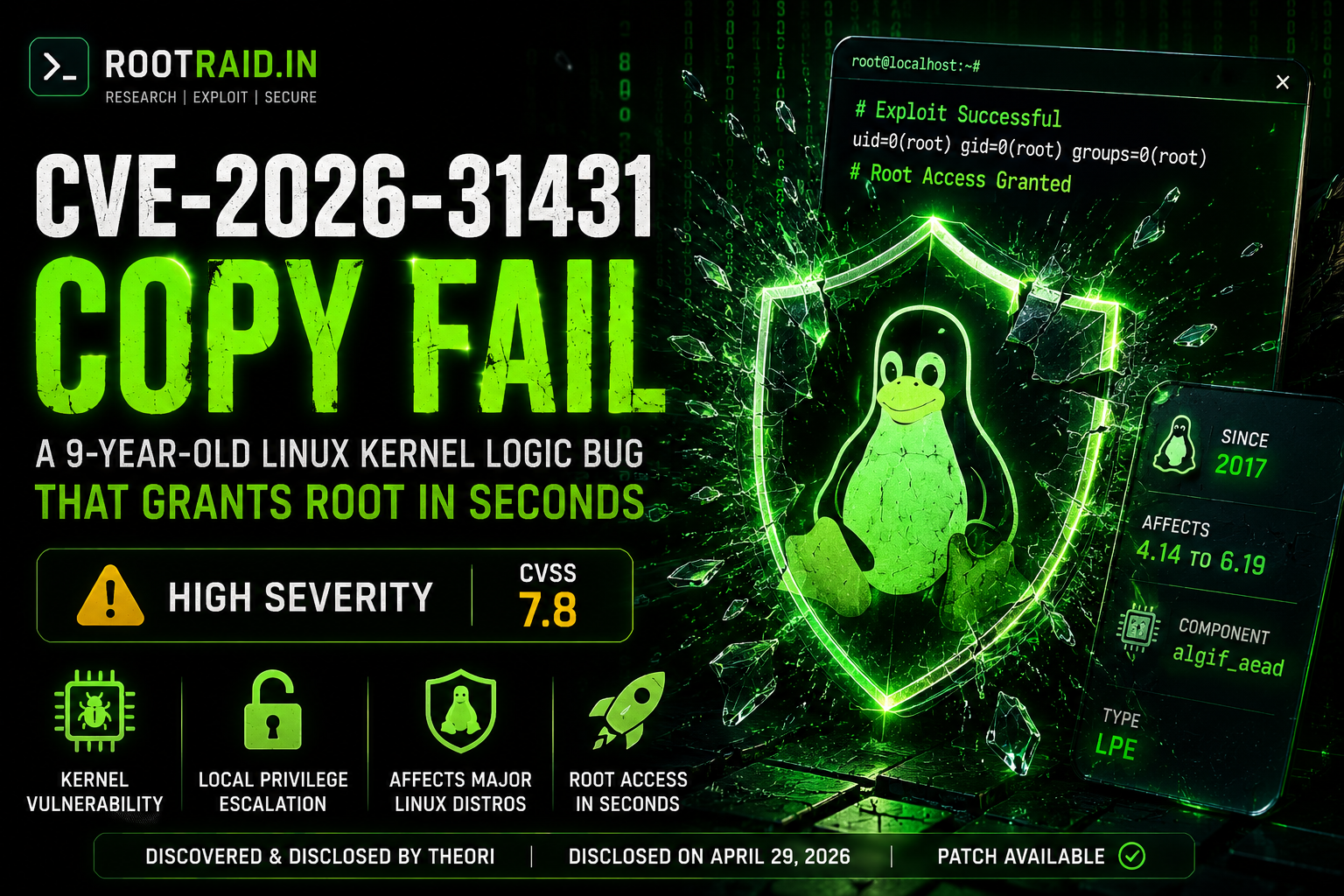
CVE-2026-31431 is a high-severity Linux kernel privilege escalation vulnerability affecting major Linux distributions released since 2017. The flaw exists within the kernel cryptographic subsystem and enables reliable elevation of privileges through a deterministic logic issue.
Copy Fail is a Linux kernel local privilege escalation vulnerability publicly disclosed in April 2026. Security researchers reported that the issue affects a large portion of Linux systems including Ubuntu, Amazon Linux, SUSE, Rocky Linux and enterprise environments.
The flaw resides within the kernel's AF_ALG cryptographic interface and can allow an unprivileged local user to gain elevated privileges under specific conditions.
Researchers described the issue as highly reliable without requiring race-condition timing.
Shared-kernel environments such as containers and Kubernetes clusters may be significantly impacted.
Multiple enterprise Linux distributions were reported as vulnerable before vendor patches became available.
| CVE | CVE-2026-31431 |
| Nickname | Copy Fail |
| Severity | High |
| Type | Local Privilege Escalation |
| Component | algif_aead |
| CVSS | 7.8 |
| Ubuntu 24.04 LTS | Affected Before Patch |
| Amazon Linux 2023 | Affected Before Patch |
| RHEL 10.x | Affected Before Patch |
| SUSE 16 | Affected Before Patch |
| Rocky Linux 9.x | Affected Before Patch |
The most notable aspect of Copy Fail is the combination of reliability, broad compatibility and stealth characteristics. Security vendors highlighted its potential impact across enterprise Linux deployments, cloud platforms and containerized workloads.
Organizations should monitor security advisories from their Linux distribution vendors and ensure kernel updates are applied as part of their regular vulnerability management process.